Roof guide
Roof repair or replacement? Know which before you spend
A leak in one spot, on a roof that is otherwise sound, usually needs a focused repair. Shingles wearing out across whole slopes, leaks that keep coming back or soft decking usually mean a new roof. Here are six signs to check from the ground, and what each one tends to point to.
The short answer
Age alone does not decide it. Condition does: how the shingles are holding up on every slope, whether leaks keep coming back, and the state of the deck underneath. Damage in one spot on a sound roof can usually be repaired. Damage spread across the roof, or a deck that has gone soft, usually means a new one.
A repair usually covers it when
- The damage is in one area, like a few lifted or missing shingles
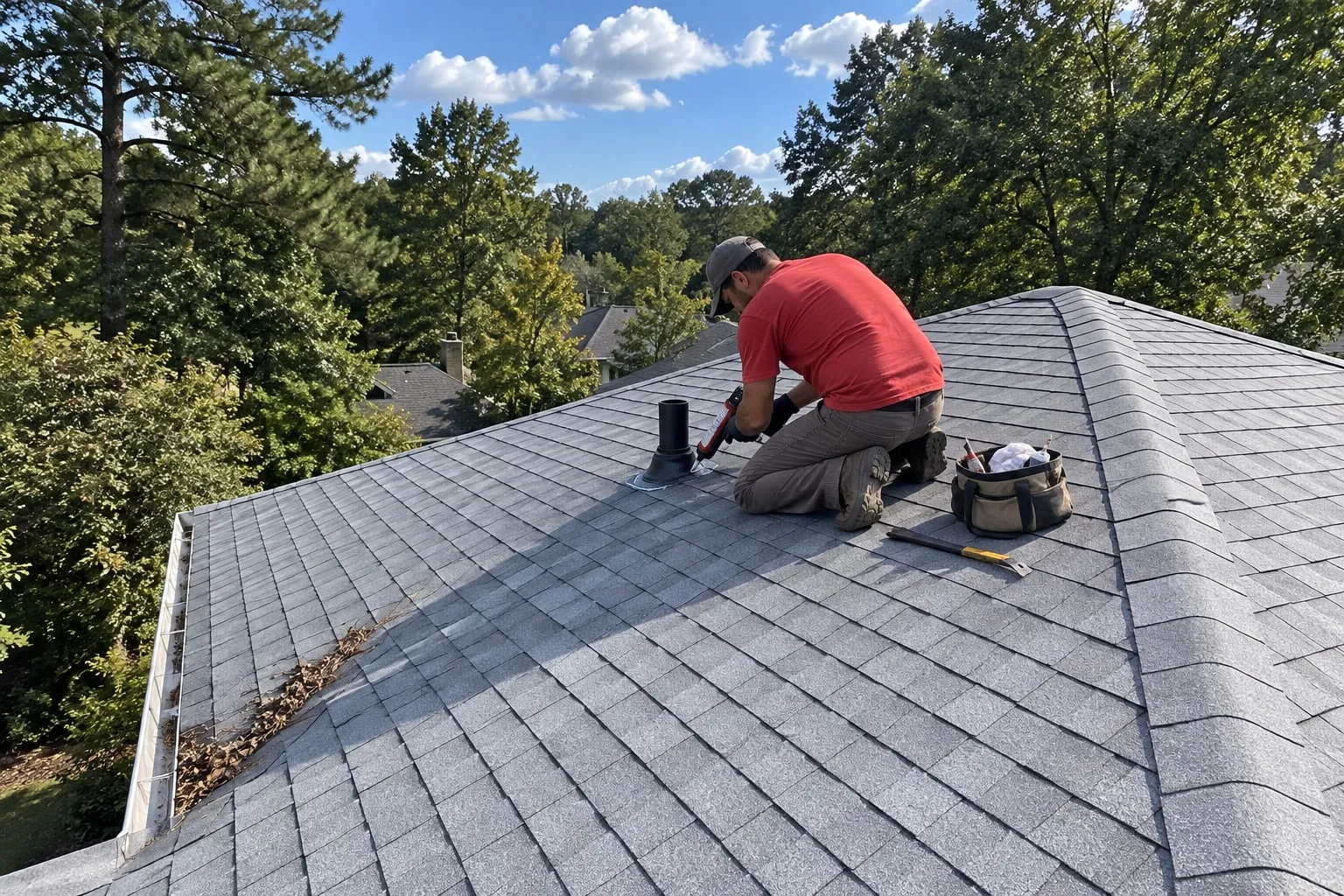
- A leak traces back to one spot, such as flashing around a vent or chimney
- The decking underneath is still solid
- The rest of the shingles still lie flat and hold their granules
- Shingles that match are still available
It is usually time for a new roof when
- Shingles are curling, cracking or going brittle across whole slopes
- You see a dip or sag in the roofline from the street
- Leaks keep coming back after repairs, or keep turning up in new places
- Water has rotted the decking in more than one place
Six signs to check
Each one says where to look. None of them needs a ladder.
- 01Attic
Attic leaks
Water stains or damp spots on the rafters and decking, or daylight showing through the boards.
What it means: Water is getting past the shingles, the underlayment or the flashing. One stain near a vent or chimney is often a repair. Stains in several places, or flashing that keeps failing, point to a wider problem.
- 02Inside
Ceiling and wall stains
Brown rings, bubbling paint or soft drywall on top-floor ceilings and the tops of walls.
What it means: A leak, or moisture trapped in the attic. Water runs along rafters before it drips, so the source can be well away from the stain. Left alone it can lead to mold, so trace it early.
- 03From the yard
Damaged shingles
Shingles that are cracked, curled at the edges, missing, or lying in the yard after a storm. Gritty granules collecting in the gutters.
What it means: A few after a storm can be replaced if the shingles around them are sound. Curling and cracking across whole slopes means the shingles are wearing out, and brittle old shingles are hard to repair without breaking more.
- 04From the street
A sagging roofline
A dip along the ridge or across a slope, or a ceiling that sags in the attic.
What it means: The decking under the shingles may be rotting from moisture. This one is worth a call soon, and it usually means replacement.
- 05Outside walls
Blistering or peeling paint
Exterior paint bubbling or peeling, especially just under the eaves.
What it means: Moisture is getting trapped in the house, often because the attic isn’t venting. The fix may be ventilation, not shingles.
- 06From the yard
Dark streaks
Black or green streaks running down the shingles.
What it means: Usually algae, moss or lichen. It looks bad but rarely needs a new roof on its own. Ask about algae-resistant shingles if you replace.
How to check your roof safely
Stay off the roof. Everything below can be done from inside the house or with your feet on the ground.
- 1
Start in the attic
- Use a flashlight to look for stains, damp spots or daylight on the underside of the roof
- Check that vents aren’t blocked by insulation or stored boxes
- 2
Walk the rooms
- Look at top-floor ceilings and the tops of walls for stains or bubbling paint
- Check around skylights and chimneys inside the house
- 3
Walk the yard
- Look for shingle pieces, flashing or granules on the ground and in the gutters
- Check gutters and downspouts for sagging or leaks
- Look under the eaves for rot or signs of animals
- 4
Step back to the street
- Look for dark patches, missing shingles or a dip in the roofline
- Binoculars help you see the shingles up close without climbing
Keep an eye on it
Know how old your roof is
If you didn’t put it on, check your home inspection report from when you bought the house. Keep a note of every repair, too: age plus a long repair history tells you more than age alone.
Check twice a year
Once in spring and once in fall, using the steps above.
Check after big storms
After high wind or hail, look as soon as it is safe to go outside. Stay clear of downed lines and damaged trees.
Watch the neighbors
Homes on your street were likely built around the same time and see the same weather. If they are getting new roofs, take a look at yours.
Damage from a storm?
Hail, wind and fallen limbs are a different conversation, because your insurance may be involved. Start with a free storm-damage inspection, and check what your policy asks you to do after a storm.
Questions homeowners askabout repair or replace.
Something else on your mind? Call (770) 432-5169
Repair or replace
Should I replace my roof at 20 years old?
Not automatically. Age is context, not a verdict. A 20-year-old roof with one bad pipe boot can be repaired. What decides it is condition: the shingles on every slope, the decking, how often it has leaked and what has already been patched.
Can I repair a roof that is missing several shingles?
Often, yes. It depends on where they came off, whether the shingles around them still lie flat and seal down, and whether matching shingles are still made. If the rest of the roof is brittle or the damage is spread across several slopes, a repair gets harder to justify.
How many times can you repair a roof before replacing it?
There is no set number. If repairs keep landing on the same failing areas, or leaks keep turning up in new places, each one buys less time, and that is the point to compare the cost of the next repair with a new roof.
Does a ceiling stain always mean I need a new roof?
No. It means water is getting in somewhere, and that needs tracing. The cause may be one flashing detail, a pipe boot, condensation in the attic or even plumbing. Find and fix the source first, then decide whether the roof as a whole is worn out.
Will a roof inspection tell me which one I need?
It tells you what can be seen: the shingles, flashing, vents and the attic where it can be reached, with photos. That is usually enough to recommend a repair or a replacement. Some damage, like soft decking, only shows once the old shingles come off, so the written estimate should say how that would be handled.
Don’t decide from a ceiling stain alone.
We look at the whole roof, not just the spot that leaked, and tell you in writing whether a repair covers it or it is time for a new roof. About roof inspections